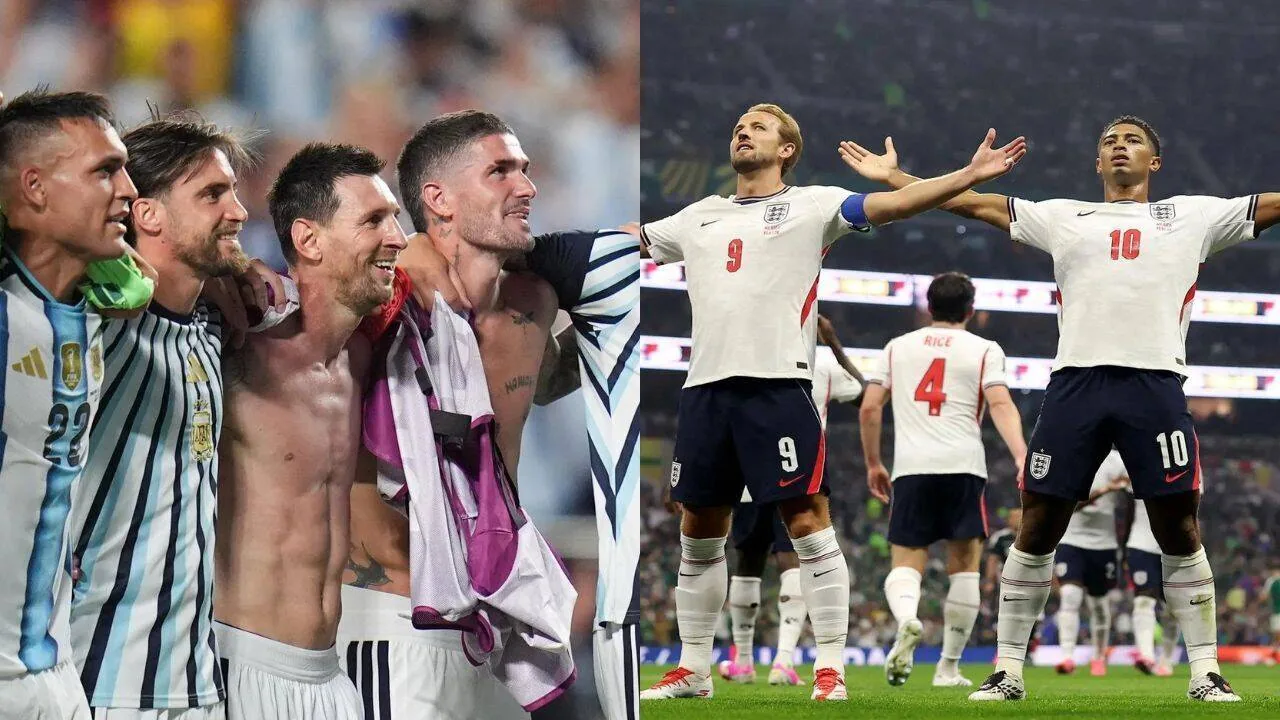
Argentina could face disciplinary action from FIFA following their celebration after defeating England in the World Cup semi-final. Players displayed a banner supporting their country’s claim to the Falkland Islands, a gesture that has previously led to fines for the Argentine Football Association.
The incident occurred after Argentina’s dramatic late comeback in Atlanta, where they scored two goals to secure a 2-1 victory against Thomas Tuchel‘s side. This win booked their place in Sunday’s final against Spain. Following the final whistle, players were seen celebrating with a banner that read “Las Malvinas son Argentinas,” which translates to “The Falklands are Argentine.”
Historical Context and Previous Incidents
The Falkland Islands, a British overseas territory located in the south-west Atlantic Ocean, have been the subject of an ongoing sovereignty dispute between Britain and Argentina. A conflict over the islands, situated 300 miles off Argentina’s east coast, took place from April to June 1982. This 74-day conflict resulted in the deaths of 655 Argentine and 255 British servicemen, along with three people from the islands.
FIFA has previously taken action against Argentina for similar displays. In 2014, the Argentine Football Association was fined £20,000 after players held up a banner with the same message before a friendly match against Slovenia. At that time, world football’s governing body stated that the gesture violated rules concerning political action and team misconduct.
The recent semi-final match itself was held under increased security measures, reflecting the historical tensions between the two nations. England ultimately lost the match due to late goals scored by Enzo Fernandez and Lautaro Martinez.
Vice President’s Remarks and Team’s Stance
Ahead of the semi-final, Argentina vice-president Victoria Villarruel sparked controversy with her comments. She posted on social media, describing England as “pirate usurpers” and invoking the Falkland Islands dispute. Villarruel stated, “Tomorrow we play against the pirate usurpers. It’s not just another match. I’m not going to be politically correct or indifferent. Against the English, it’s always something more. It’s the Falkland Islands (Malvinas), it’s Diego (Maradona), it’s Leo’s (Messi’s) last one, and it’s about standing up to the invaders. Long live Argentina! Because until our last breath, we’ll keep demanding what’s ours!”
After Argentina’s victory, Villarruel again posted, saying “it wasn’t just another match” and sharing a video that appeared to show Argentine soldiers. She reiterated, “The Falklands are Argentine. They banned bringing them to the stadium and forgot that we carry them in our blood and our hearts.”
Despite these sentiments from the vice-president, Argentina’s manager, Lionel Scaloni, had expressed a different view before the semi-final. He stated that he was “not going to mix” football and politics. Scaloni commented, “The reality is that this is a football match. I can’t mix things up, especially out of respect for what happened so many years ago. It was a very sad period in our history, and there isn’t much we can do about it, that’s the reality. Things are happening elsewhere in the world, and we criticise the existence of war. We certainly remember those people, of course. But it is a football match – we shouldn’t confuse the two.”
Argentina players had also reportedly sung chants referencing the Falklands, Maradona, and Messi after their 3-2 win against Egypt in the last 16 round.
Messi’s First Encounter with England
The semi-final match marked a significant moment for Argentina captain Lionel Messi, as it was his first time facing England in his international career. Despite representing Argentina for over two decades and playing against every other FIFA World Cup-winning nation, Messi had not previously competed against the Three Lions.
Messi acknowledged the significance of the match after Argentina’s 3-1 extra-time victory over Switzerland in the quarter-finals. He described it as “special” because it was his first encounter with England, a team he considers a “big team, a powerhouse.” He added that playing against such teams in a World Cup semi-final makes the experience particularly memorable.
This contest revived one of international football’s long-standing rivalries. The last competitive fixture between England and Argentina was in the 2002 FIFA World Cup, where England secured a 1-0 victory. Argentina reached the semi-finals by winning all three of their Group J matches and then overcoming Cabo Verde, Egypt, and Switzerland in the knockout rounds. They scored nine goals across their three knockout fixtures, the highest tally among the semi-finalists. England, on the other hand, advanced after a 2-1 extra-time win over Norway, with Jude Bellingham scoring a brace, and earlier defeated DR Congo and Mexico by one-goal margins.
The upcoming final will see Argentina play Spain.
Read Also
- England faces Argentina in World Cup semi-final with minimal injury concerns
- Deschamps questions referee's performance after France's World Cup semi-final exit
- Atlanta to host high-risk England versus Argentina semi-final match
- Atlanta witnesses Argentina's comeback win over England to reach World Cup final
Source: bbc.com