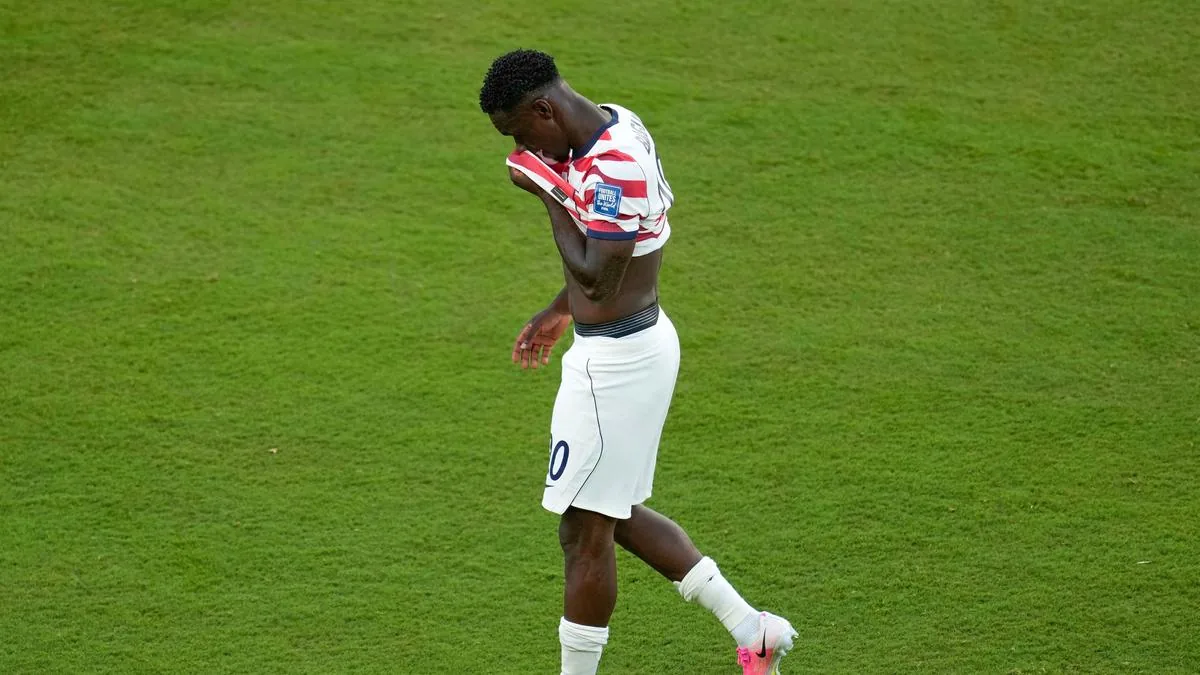
Former FIFA president Joseph “Sepp” Blatter has voiced concerns regarding the governing body’s decision to lift Folarin Balogun’s World Cup suspension. Blatter stated that football should not become a “playground for political power” following the overturning of Balogun’s automatic one-match ban, which occurred before the United States’ Round of 16 match against Belgium.
The decision to clear Balogun came after U.S. President Donald Trump reportedly contacted FIFA president Gianni Infantino to request a review of the red card. Blatter, who led FIFA from 1998 to 2015, expressed his views on X, questioning the independence of football’s disciplinary process.
“Red cards are not overturned by political phone calls. They are overturned by rules, evidence and independent bodies,” Blatter wrote. He further questioned FIFA’s direction, stating, “If a U.S. President intervenes with the FIFA President – and a player is suddenly cleared before a World Cup knockout match – the question is unavoidable: Quo vadis, FIFA? Football must never become a playground for political power.”
Controversial Decision and Reactions
Balogun received a red card during the United States’ 2-0 Round of 32 victory over Bosnia and Herzegovina. The dismissal, issued by Brazilian referee Raphael Claus after a VAR review, was for catching Tarik Muharemović on the ankle, and it typically triggers an automatic one-match suspension.
However, FIFA announced that the suspension was lifted under Article 27 of its disciplinary rules. Instead of an immediate ban, Balogun’s suspension was placed on probation for one year. This means that if he commits a similar offence within that period, the suspension will be activated in addition to any further disciplinary action.
President Trump publicly thanked FIFA for reversing what he called “a great injustice.” This decision drew significant attention and criticism from various quarters.
The Royal Belgian Football Association (RBFA) reacted strongly, expressing astonishment and indicating that it was exploring all available options to protect the integrity of the competition. Belgium head coach Rudi Garcia also criticised the ruling, describing it as unprecedented in World Cup history and questioning the message it conveyed about the tournament’s disciplinary process. Garcia remarked, “I didn’t know that [at] the Fifa World Cup 5 July is now 1 April, and that is April Fool’s. We are not defending the national team or the federation; we are defending football.”
Conversely, U.S. head coach Mauricio Pochettino welcomed FIFA’s ruling. He maintained that Balogun’s original dismissal was unfair and argued that his team had already been sufficiently penalised by playing with 10 men for the remainder of the match against Bosnia and Herzegovina.
Impact on Disciplinary Process
The controversy has become a major talking point of the tournament, with Blatter’s remarks intensifying scrutiny on FIFA’s handling of disciplinary decisions. The incident has also led to questions about consistency in VAR decisions and disciplinary actions.
England coach Thomas Tuchel also commented on the confusion surrounding the disciplinary process after FIFA’s decision regarding Balogun. Tuchel questioned the implications for other red card incidents, such as the one involving Jarell Quansah in England’s 3-2 win over Mexico.
“Where does this start and where does this end now?” Tuchel asked. “Can we overturn it or not overturn it? What’s going on? Where to draw the line is the question that I ask. I have no answer to that.” He highlighted that both Balogun and Quansah were sent off following VAR reviews.
Tuchel further questioned the basis for overturning decisions, stating, “Who overturns this decision and on what grounds? And how far does this go now? It’s just strange for me. We just want to have consistency in the decisions.” He added that he believed Balogun’s incident was not a red card, despite VAR involvement.
The RBFA claims that FIFA’s decision contradicts its own disciplinary code and the competition regulations for the tournament. Article 66.4 of the code states that a red card automatically results in a suspension for the team’s next match, a rule that has been applied to all other red cards in this World Cup. The decision on Balogun also goes against Article 10.5 of the FIFA World Cup 2026 Competition Regulations, which reiterates automatic suspension. The Belgian footballing body is investigating all options to safeguard “the legitimate rights of all participating teams and to protect the fundamental principles of fair play” in the sport. If Balogun plays, it would mark only the second instance in World Cup history where a player did not serve a suspension after receiving a red card, with the first occurring in 1962 when Brazil’s Garrincha played in the final after a semi-final red card, though automatic suspensions were not in place then.
Read Also
- Los Angeles: Marc Cucurella's goal disallowed in Spain vs Austria World Cup 2026 match
- Senegal faces World Cup agony after late collapse against Belgium
- Julian Nagelsmann resigns as Germany head coach; Jurgen Klopp a potential successor
- Spain advances to World Cup last 16 with dominant win over Austria
Source: timesofindia.indiatimes.com