Economist’s prediction model falters
Economist and football forecaster Joachim Klement, known for his successful World Cup predictions, has seen his streak come to an end. For the first time in four editions of the men’s tournament, Klement’s economic model failed to correctly predict the winning nation. His model had previously identified the winners of the 2014, 2018, and 2022 tournaments.
Klement’s model had pointed towards Ronald Koeman’s Netherlands side as the potential champions for this year’s tournament. The Dutch team showed strong form in the group stages, including a 5-1 victory over Sweden, which saw them top Group F. However, their journey concluded in the last 32 after a penalty shootout against Morocco, marked by several missed spot-kicks.
Reflecting on the outcome, Klement acknowledged the role of luck in his predictions. He stated on his investment blog, “Eventually, after 12 years and being lucky in three World Cups, I ran out of luck. I set out to prove that economic models are not as accurate as many people believe and finally, I was proven right.” He also noted the unpredictable nature of knockout matches, particularly penalty shootouts, where outcomes can easily swing either way.
The economist had previously used the World Cup as an example to illustrate that forecasts from economists and financial experts are often taken too literally, overlooking the numerous factors that can influence outcomes. He initially built his model in 2014 to demonstrate that predicting winners was practically impossible, only to be surprised by its initial success.
Additional predictions and reactions
The prediction for the Netherlands was not the only one that did not materialise. Klement’s model also suggested that Japan would defeat Brazil in an early stage of the tournament. This prediction was overturned when Gabriel Martinelli secured a stoppage-time goal for Brazil. Following this, Neymar, the veteran forward, took to social media platform X to address Klement, posting, “Mr Joachim Klement … Please try again in the next World Cup.”
In response to Neymar’s comment, Klement expressed his support for Brazil, stating, “after last night I dare to believe as well.” However, Klement’s model had also predicted Germany would advance to the last 16, which could cause some apprehension among Brazil supporters regarding their upcoming match against Norway on Sunday.
Klement’s model incorporates several systemic factors, including population, national wealth, climate, and FIFA World Rankings. The FIFA World Ranking is considered the most predictive factor, reflecting the current generation of players’ quality. GDP per capita is another significant factor, as it indicates a country’s ability to invest in player development from a young age. Less influential factors include population size and temperature.
Despite the recent setbacks, Klement intends to continue his World Cup forecasts. He views the exercise as a form of entertainment and a way to highlight that luck is a crucial element in such predictions. He plans to return with new forecasts in four years, hoping that people will have a better understanding of his message regarding the role of luck and the limitations of models in making perfect predictions.
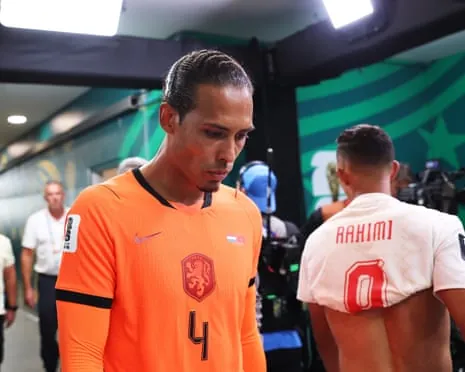
He also apologised to the Dutch national team and their fans if he had provided false hope, acknowledging their unluckiness in the recent match. Klement believes the Dutch team has the potential to win a major trophy, possibly at the Euros in two years, though he stated he would not be making forecasts for that tournament. He expressed pride in the Dutch team’s performance, noting that experts had considered them a strong contender after the group stages.
Read Also
Source: theguardian.com