Olympic medallist Manu Bhaker addresses public discourse
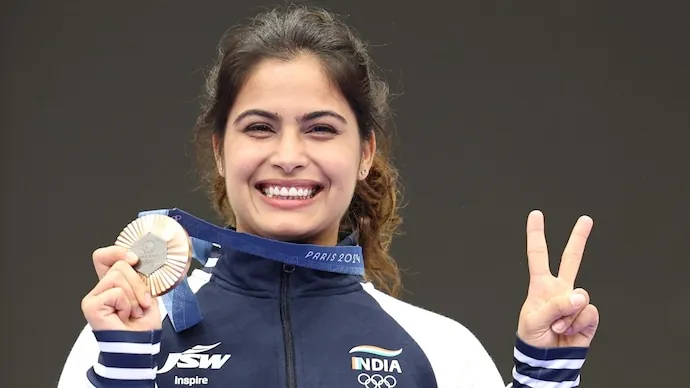
Manu Bhaker, a two-time Olympic medallist in shooting, has voiced her concerns regarding the increasing normalisation of abusive language, particularly among the younger generation. She emphasised the importance of choosing words carefully, stating that language reflects an individual’s personality and character. Bhaker asserted that using bad language is not a sign of being “cool.”
Her remarks contribute to a broader discussion about the use of cuss words, which has become a national debate. Bhaker’s comments follow incidents where videos from a protest by the Cockroach Janta Party (CJP) at Jantar Mantar in New Delhi showed protesters using profane slogans. These videos sparked a wider conversation about the boundaries of political expression and public discourse.
Bhaker, who recently secured a bronze medal in the 25m pistol event at the ISSF World Cup in Hangzhou, China, also shared her thoughts on social media. She urged social media influencers to act responsibly and promote positivity, highlighting that negative comments can significantly impact individuals. She stressed the importance of kindness and mutual support, noting that success is not achieved by pulling others down.
Defining true “coolness”
In a post on X, Bhaker elaborated on her definition of “coolness,” suggesting it is rooted in values rather than vocabulary. She stated that true coolness involves being hardworking, kind, and respectful towards others and oneself. Additionally, she mentioned striving for success through honesty and making one’s parents and country proud as key aspects of being “cool.”
The Olympian explained her decision to speak on the issue by noting the gradual normalisation of abusive language. She observed that for many, particularly younger individuals, using such words has become so commonplace that it is even considered “cool.” Bhaker highlighted that people are casually using degrading and disrespectful language in everyday conversations without fully realising its impact.
While Bhaker did not reference a specific incident, her comments came less than a week after the CJP agitation at Jantar Mantar concluded. During this agitation, videos circulated on social media depicting younger participants using profane slogans directed at Prime Minister Narendra Modi.
Public figures weigh in on the debate
The debate surrounding the language used during the protests has drawn reactions from several public figures. Prime Minister Modi himself shared a video message on Instagram, indicating he had forgiven the students who used abusive language during the recent protest at Jantar Mantar. He urged society to guide these individuals rather than seek punishment, stating that childhood is a time for correcting mistakes.
Veteran actor Anupam Kher also joined the discussion, expressing his dismay at the abusive language directed at the Prime Minister. While congratulating students on achieving their protest objectives, Kher emphasised that democracy grants the right to dissent but not the right to disrespect. He argued that respecting the dignity of the Prime Minister’s office is crucial, regardless of political differences, and that the issue extends beyond politics to the culture being passed to future generations.
Actor Ashutosh Rana also contributed to the conversation, stressing the importance of responsible public discourse. Rana’s comments were made in response to remarks by actor and BJP MP Kangana Ranaut, who had criticised the language used by some young protesters, describing it as “puke-inducing” and referring to sections of Gen Z as a “gutter generation.” Rana distinguished between movements and revolutions, advocating for constructive expression among young people.
He used a metaphor to illustrate the significance of language, noting that “Lions roar, elephants trumpet and dogs bark. Every animal is recognised by its sound and the way it expresses itself. Our words decide whether we receive respect or shame.” These varied perspectives from Bhaker, Kher, Rana, and Ranaut have further intensified the discussion on whether political dissent can remain impactful without resorting to abuse and how the normalisation of profanity might be shaping the culture of India’s younger generation.
The debate over the use of language in public discourse continues to evolve following the protest at Jantar Mantar.
Source: indiatoday.in